Crecimiento y desarrollo humano: etapas, esferas y hormonas clave
Documento de Universidad sobre Crecimiento y Desarrollo. El Pdf es una recopilación de apuntes esquemáticos de Biología, que aborda las etapas del desarrollo, las esferas de desarrollo y el papel de hormonas como la vitamina D y la GH, así como los procesos de osificación.
Ver más16 páginas

Visualiza gratis el PDF completo
Regístrate para acceder al documento completo y transformarlo con la IA.
Vista previa
Crecimiento y Desarrollo
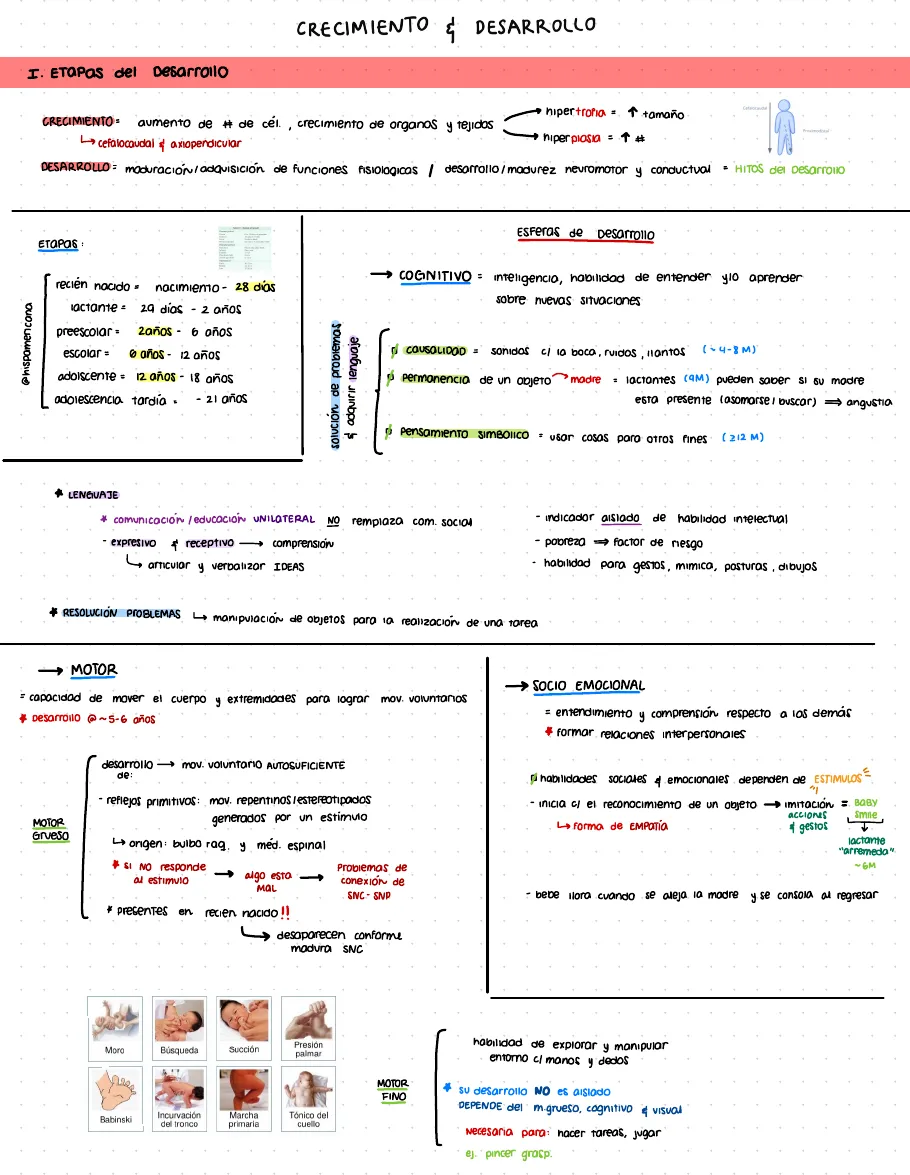
CRECIMIENTO DESARROLLO
Etapas del Desarrollo
CRECIMIENTO= aumento de # de cél , crecimiento de organos y tejidos > cefalocaudal & axiopendicular hipertrofia = ^ tamaño Cefalocaudal Proximodistal - DESARROLLO = maduración/ adquisición de funciones fisiologicas / desarrollo/ madurez neuromotor y conductual = HITOS del Desarrollo .
Esferas de Desarrollo
ETAPAS : School ip-drill ESFeras de Desarrollo
Desarrollo Cognitivo
COGNITIVO = inteligencia, habilidad de entender ylo aprender sobre nuevas situaciones sociedad ar monios $ adquirir lenguaje CAUSALIDAD = sonidos c/ la boca, ruidos, llantas (~4-8M) la permanencia de un objeto madre = Idctantes (M) pueden saber si su madre esta presente (asomarse / buscar) angustia. Pensamiento SIMBOLICO = usar cosas para otros fines (212 M)
Lenguaje
LENGUAJE
- comunicación / educación UNILATERAL NO remplaza com. social
- expresivo receptivo -> comprensión 4 articular y verbalizar IDEAS
- Indicador aislado de habilidad intelectual
- pobreza > factor de riesgo
- habilidad para gestos; mimica, posturas , dibujos
Resolución de Problemas
* RESOLUCIÓN PROBLEMAS > manipulación de objetos para la realización de una tarea
Desarrollo Motor
- MOTOR = capacidad de mover el cuerpo y extremidades para lograr mov. voluntarios
- Desarrollo @~5-6 años MOTOR Grueso >> origen: bulbo raq. y med. espinal
- SI NO responde al estimulo -> algo esta Mal Problemas de conexión de SNC - SNP
- presentes en recien nacido! desaparecen conforme madura SNC Moro Búsqueda Succión Presión palmar MOTOR FINO Babinski Incurvación del tronco Marcha primaria Tónico del cuello
Desarrollo Socio Emocional
SOCIO EMOCIONAL = entendimiento y comprensión respecto a los demás
- formar relaciones interpersonales ri habilidades sociales & emocionales dependen de ESTÍMULOS-
- inicia ci el reconocimiento de un objeto ->imitación = BABY . acciones. smile La forma de EMPATÍA $ gestos lactante "arremeda" ~ 6M
- bebe ilora cuando se dieja la madre y se consola al regresar habilidad de explorar y manipular entorno c/ manos y dedos
- su desarrollo NO es aislado DEPENDE del m.grueso, cognitivo & visual Necesaria para: hacer tareas, jugar ej . pincer grasp . @hispamencapa
Etapas de la Vida
recién nacido = nacimiento - 28 días lactante = 29 días - 2 años preescolar = 2años - 6 años escolar = . 6 años - 12 años adolescente = 12 años - 18 años daorescencia tardía = . - 21 años hiperplasia = 1 # desarrollo -> mov. voluntario AUTOSUFICIENTE de. - reflejos primitivos. mov. repentinos / estereotipados generados por un estímulo
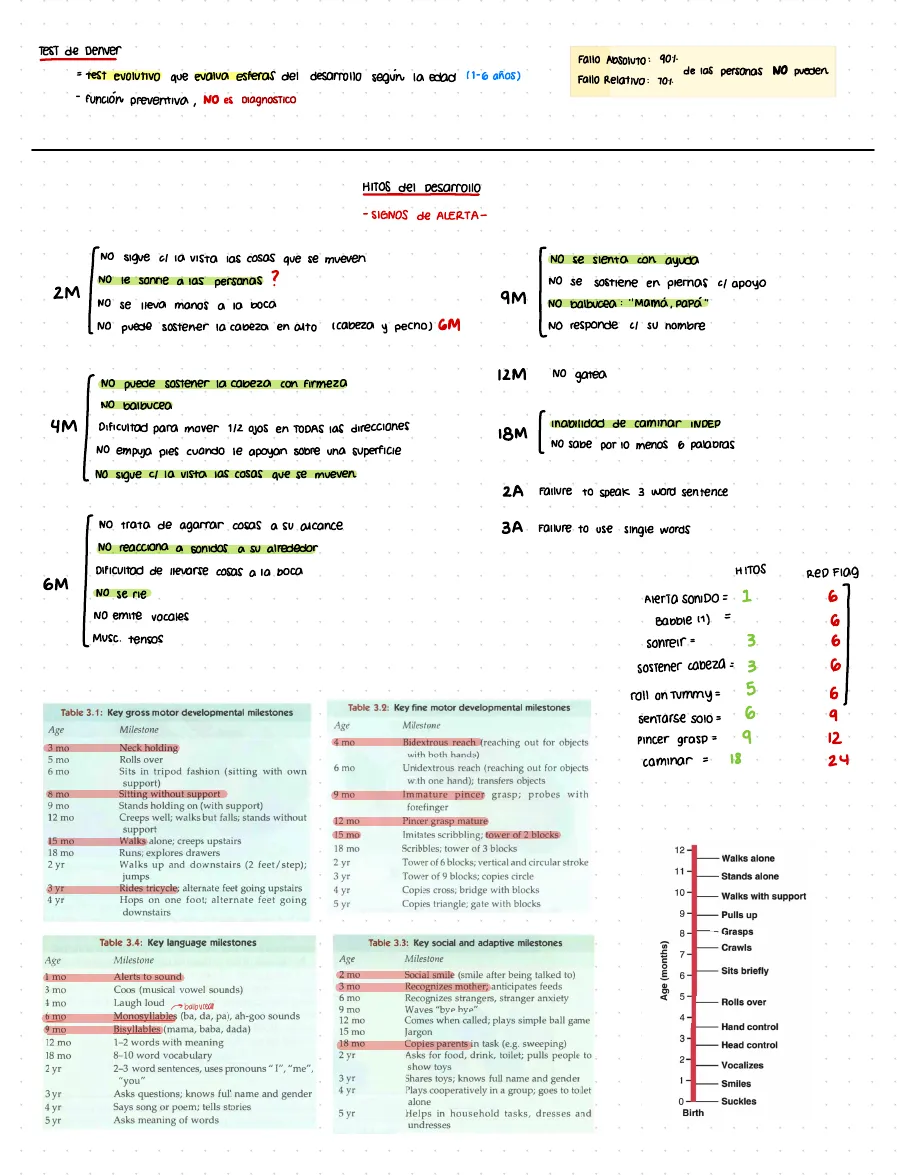
Test de Denver
TEST de Denver = test evolutivo que evalua esferas del desarrolla según la edad (1-6 años) - función preventiva, NO es Diagnostico Fallo Absoluto : 90% de las personas NO pueden. Fallo Relativo. 101
Hitos del Desarrollo y Signos de Alerta
HITOS del Desarrollo - SIGNOS de ALERTA -
Hitos a los 2 Meses
2M NO sigue c/ Id vista las cosas que se mueven NO le sonne a las personas ? NO se lleva manos a la boca NO puede sostener la cabeza en alto (cabeza y pecho) GM
Hitos a los 9 Meses
9M NO se sienta con ayuda NO se sostiene en piernas c/ apoyo NO balbucea · "Mamá, papá" NO responde ci su nombre
Hitos a los 12 Meses
12M. NO gatea NO puede sostener la cabeza con firmeza NO balbucea Dificultad para mover 1/2 ojos en TODAS las direcciones NO empuja pies cuando le apoyan sobre una superficie
Hitos a los 18 Meses
18M Inabilidad de caminar INDEP NO sabe por lo menos 6 palabras
Hitos a los 2 Años
2A . Failure to speak 3 word sentence
Hitos a los 3 Años
3A Failure to use single words
Hitos Clave
HITOS RED Flag AlerTa SONIDO = 1 6 Babble ( 1 ) 6 sobreir = 3 6 sostener cabeza = 3 6 5 6 sentarse solo = 6 9 pincer grasp = 9 12 caminar = 18 24
Hitos del Desarrollo Motor Fino
Table 3.2: Key fine motor developmental milestones
| Age | Milestone | Age | Milestone |
| 3 mo | Neck holding | 5 mo | Rolls over |
| 6 mo | Sits in tripod fashion (sitting with own support) | 8 mo | Sitting without support |
| 9 mo | Immature pincer grasp; probes with forefinger | 12 mo | Pincer grasp mature |
| 15 mo | Imitates scribbling; tower of 2 blocks | 18 mo | Scribbles; tower of 3 blocks |
12- Walks alone 11 - Stands alone 10- - Walks with support 9 - Pulls up 8 - Grasps
Hitos Sociales y Adaptativos
Table 3.3: Key social and adaptive milestones
| Age | Milestone |
| 2 mo | Social smile (smile after being talked to) Recognizes mother; anticipates feeds |
| 3 mo | Coos (musical vowel sounds) |
| 4 mo | Laugh loud - balbucear |
| 9 mo | Waves "bye bye" |
| 12 mo | Comes when called; plays simple ball game Jargon |
| 18 mo | Copies parents in task (e.g. sweeping) |
| 2 yr | Asks for food, drink, toilet; pulls people to show toys |
| 3 yr | Shares toys; knows full name and gender |
| 3 yr | Asks questions; knows full name and gender |
| 4 yr | Plays cooperatively in a group; goes to toilet alone |
| 0- Suckles | 4 yr |
| 5 yr | Asks meaning of words |
| 5 yr | Helps in household tasks, dresses and undresses |
Age (months) 7- Sits briefly 6 - 5- Rolls over 4 - Hand control Head control 2- Vocalizes
Hitos del Lenguaje
Table 3.4: Key language milestones
| Age | Milestone |
| 1 mo | Alerts to sound |
| 3 mo | 6 mo Recognizes strangers, stranger anxiety |
| 6 mo | Monosyllables (ba, da, pa), ah-goo sounds Bisyllables (mama, baba, dada) |
| 9 mo | Stands holding on (with support) |
| 12 mo | Creeps well; walks but falls; stands without support |
| 15 mo | Walks alone; creeps upstairs |
| 18 mo | Runs; explores drawers |
| 12 mo | 1-2 words with meaning |
| 18 mo | 8-10 word vocabulary |
| 2 yr | 2-3 word sentences, uses pronouns " I", "me", “you” |
| 2 yr | Tower of 6 blocks; vertical and circular stroke |
| 2 yr | Walks up and downstairs (2 feet/step); jumps |
| 3 yr | Tower of 9 blocks; copies circle |
| 4 yr | Copies cross; bridge with blocks |
| 4 yr | Rides tricycle; alternate feet going upstairs Hops on one foot; alternate feet going downstairs |
| 5 yr | Copies triangle; gate with blocks |
NO trata de agarrar cosas a su alcance NO reacciona a sonidos a su alrededor
Hitos del Desarrollo Motor Grueso
6M Dificultad de llevarse cosas a la boca NO se rie NO emite vocales Musc. tensos Table 3.1: Key gross motor developmental milestones
| 9 mo | 3 yr |
| Crawls | 15 mo |
| 3- Birth | 4M |
NO sigue c/ la vista las casas que se mueven roll on Tummy =Area
Banderas Rojas por Edad
| 6 months | 9 months | 12 months | 18 months | 2 years | 3 years | 4 years | 5 years | Red flags at any age | |
| Social emotional | Does not smile or interact with people | Not sharing enjoyment with others using eye contact or facial expression | Does not notice someone new | Lacks interest in playing and interacting with others | When playing with toys tends to bang, drop or throw them rather than use them for their purpose (e.g. cuddle dolls, build blocks) | No interest in pretend play or interacting with other children | A Unwilling or unable to play cooperatively | Play is different than their friends | Strong parental concerns Significant loss of skills |
| Communication | Not starting to babble (e.g. aahh; oohh) | Not using gestures (e.g. pointing, showing, waving) | No babbled phrases that sound like talking | No clear words | Not learning new words | Speech difficult for familiar people to understand | Speech difficult to understand | Difficulty telling a parent what is wrong | Lack of response to sound or visual stimuli Poor interaction with adults or other children |
| Not using two part babble (e.g. bubu, dada) | No response to familiar words (e.g. bottle, daddy) | Not able to understand short requests (e.g. 'Where is the ball?') | Not putting words together (e.g. 'push car') | Not using simple sentences (e.g. 'Big car go') | Not able to follow directions with two steps (e.g. 'Put your bag away and then go play') | Not able to answer questions in a simple conversation (e.g. 'What's your name? Who is your family? What do you like to watch on TV?') | Lack of, or limited eye contact | ||
| Cognition, fine motor and self care | Not reaching for and holding (grasping) toys | Does not hold objects | Does not feed self finger foods or hold own bottle/ cup | Does not attempt to feed self using a spoon and/or help with dressing | Does not attempt everyday self care skills (such as feeding or dressing) | Not able to draw lines and circles | Not able to independently complete everyday routines such as feeding and dressing | Does not bring hands together at midline | Not able to draw simple pictures (e.g. stick person) |
| Does not 'give' objects on request | Does not attempt to stack blocks after demonstration | Does not explore objects with hands, eyes and mouth | Cannot move toy from one hand to another | Unable to pick up small items using index finger and thumb | . Difficulty in manipulating small objects (e.g. threading beads) | Marked low tone (floppy) or high tone (stiff and tense) and significantly impacting on development and functional motor skills | |||
| Gross motor | Not rolling | Not sitting independently/ without support | No form of independent mobility (e.g. crawling, commando crawling, bottom shuffle) | Not standing independently | Not attempting to walk without support | Not able to walk independently | Not able to walk up and down stairs holding on | Not able to walk up and down stairs independently | Not able to walk, run, climb, jump and use stairs confidently |
| Not holding head with control in supported sitting | Not moving (e.g. creeping, crawling) | Not taking weight on legs when held in standing | Not pulling to stand independently and holding on for support | Does not scribble with a crayon | Not toilet trained by day | Concerns from teacher about school readiness | Not able to walk, run, climb, jump and use stairs confidently | Not holding head and shoulders up with good control when lying on tummy | |
| Not able to run or jump | Not able to catch, throw or kick a ball | Not able to hop five times on one leg and stand on one leg for five seconds | |||||||
| Differences between right and left sides of body in strength, movement or tone | |||||||||
| Hands frequently clenched | Does not play early turn-taking games (e.g. peekaboo, rolling a ball) | Difficulty noticing and understanding feelings in themselves and others (e.g. happy, sad) |
Adaptación a la Vida Extrauterina
Circulación Fetal
II. ADAPTACIÓN de la VIDA extrauterina circulaToria PO2 = 30 mmHg - ongen: placenta ( saturada 80% de 02) circulación FETAL - AVA - v. umbilical Mayona cruza el conducto venoso" 102 V cava INF. +02 sangre de la vena cava INF. guia sangre - AGUJero OVAL mayona de la sangre se dirige . cantidad peq. drena @ sinusodes mecanismo de esfínter: controla el flujo sang de la v.umbilical -> sinusoldes hep. se cierra cuando una contracción uterina 1 retorno venoso > Evitando sobrecarga Auricula 12Q. ventriCULO pesoxigenada / PO2 = 12-14 mmHg Superior vena cava Superior vena cava 62 Crista dividens- Ductus arteriosus 52 Right Pulmonary artery 52 Inferior vena cava Pulmonary veins 42 Foramen ovale 67 Right atrium Left atrium Left ventricle Right ventricle Inferior vena cava 67 Ductus venosus PO2 = 26-28 mmHg Umbilical vein 80 Inferior vena cava 27 Portal vein- 40% Descending aorta 58 K 65% -> Placenta (WASTE & CO2 ) 35% -> organos (02) 3 Ductus arteriosus Superior vena cava 2 Foramen ovale Pulmonary pulmón pulmón vena cava inferior hígado AD el foramen ovale se convierte en la fosa oval vena porta hepática la vena umbilical se convierte en el ligamento Credondo ombligo arteria ilíaca común las arterias umbilicales se convierten en los ligamentos umbilicale mediales + Disminuye por la Interrupción de la sangre placentaria * cambio de presiones + primera respiración empuja primum contra secundum * cierre reversible @ primeros dias * A.O permedble = cierre imperfecto (20% individuos) * Puede Tardar 1-3 Meses * Mediada por Bradicina liberada por pulmones @ Insuflación Inicial * ParTes DISTAIES - 119. umbilicales medios prox art . vesicales sup . ¥ 1-5hrs postpartum L To placenta arteries From placenta Low D Very low O Primera INSUFLACIÓN 1 RV pulmonar >vasodilatación . sangre hacia los pulmones aumenta 4 Septum Foramen secundum secundum . Foramen - - Septum primum ovale Septum- secundum 2 septum Primum se opone di secundum Ajugero oval cierra 3. TO2 & Prostaglandinas = CIOSE cond. arterioso ( par contracción musc. refleja) ocasionada por el pinzamiento del cordón 4. Art. umbilicales'se cierran @min desp. del nacimiento 5. v.umbilical ligamento *cond. venoso venoso vena cava superior tronco pulmonar aorta ELSEVIER -> solo 10% atraviesa los pulmones , pq. se encuentran colapsados = resistencia vascular ventriCULO Der: - > ATT. PULMONar- junto c/ sangre de V. cava sup ( cabeza & brazos). CONDUCTO Arterial atrium * borde INF. del septum secundum evita que. pase peg. cant. 1 Left atrium Aorta 25 Koeppen & Stanton: Berne and Levy Physiology, 6th Edition. Copyright 2008 by Mosby, an imprint of Elsevier, Inc. All rights reserved Portal vein- Umbilical vein Internal iliac arbery -Und lical Aort Umbilical arteries 58 Inferior vena cava - ATT Ilaca INT. Hich O Moderate O, Presión de Auricula IZQ Auricula DER .* redondo * mezcla sangre proveniente del ventriculo DER +aorta / evita que un exceso de sangre se vaya a los pulmones inmaduros (NO soportarian la presión) ~ Flujo Unidireccional~ * > Auricula Der. aquí se mezcla c/ sangre desoxigenada que retorna de extr. INF.
¿Non has encontrado lo que buscabas?
Explora otros temas en la Algor library o crea directamente tus materiales con la IA.